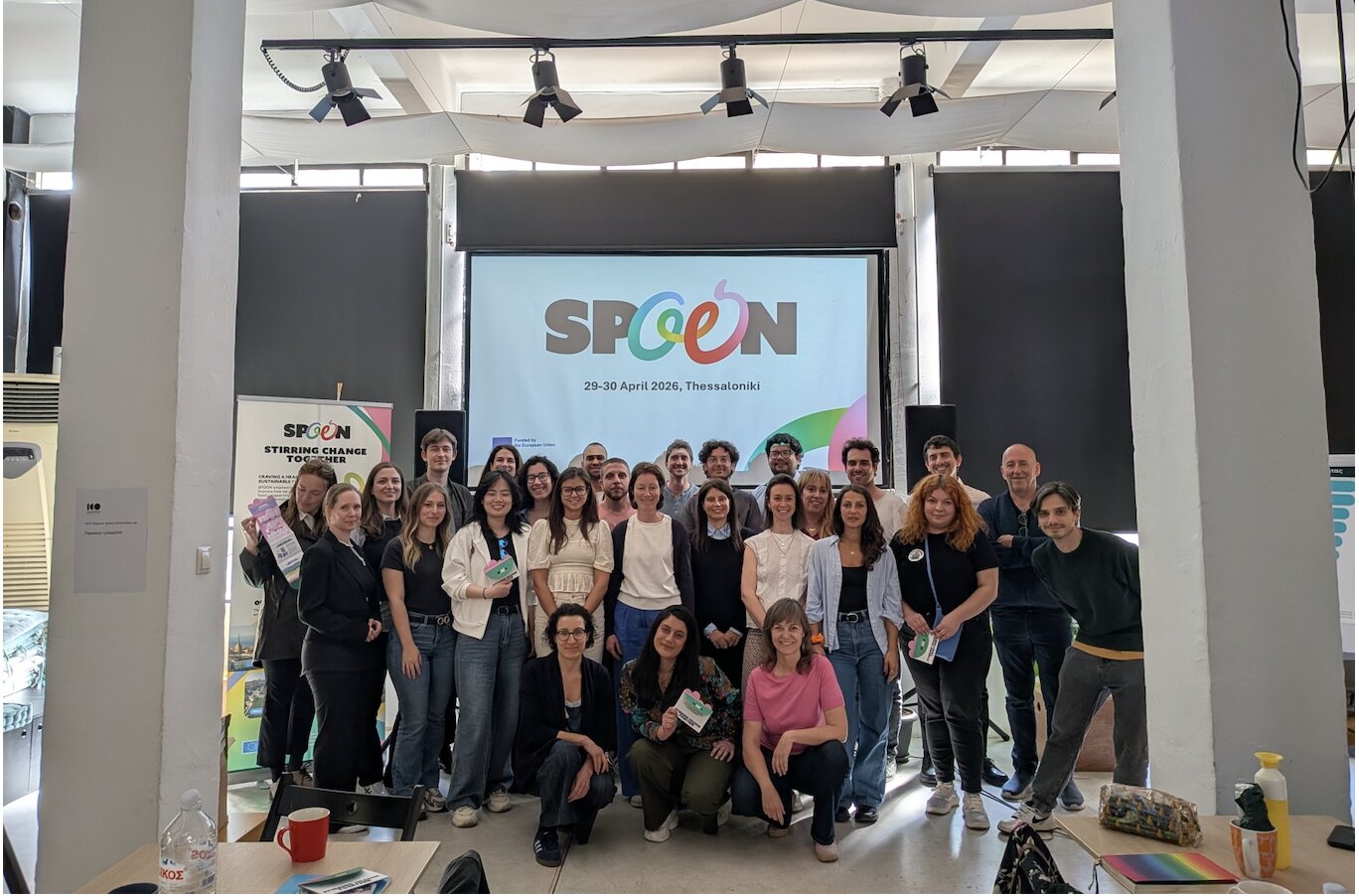
From 29 to 30 April, the SPOON consortium gathered for its annual in-person meeting in the beautiful city of Thessaloniki, Greece. Hosted by our partner INCOMMON, the meeting provided a valuable opportunity to review progress and align on the next steps in our journey towards more sustainable food consumption.
Over two days of discussions, partners reflected on both theoretical and methodological advancements, as well as progress at the pilot level. Our partner ILVO is advancing its work on food system dynamics, including research into the barriers of citizen data collection and the behavioural factors shaping food consumption across Europe. Meanwhile, the Science for Change team continues to refine the human-centred methodological framework, identify key stakeholders for each Citizen Science Lab (CSL), and support local implementation teams.
Under the guidance of the project coordinator CSCP, the initial phase of pilot activities has now been completed, with a total of 15 workshops held across local contexts. In the coming months, CSL participants will move into the co-design phase, working together with food system actors and stakeholders from related sectors to develop small-scale behavioural change interventions.
At the same time, the SPOON digital toolset, designed to better understand food behaviours in real-life contexts, is taking shape. Led by JIBE, this work focuses on capturing real-time behavioural data while ensuring that users remain fully in control of their personal information.
Evaluation activities are being led by AIT, which is developing a comprehensive framework to assess both the effectiveness of pilot actions and the overall impact of the project. In parallel, ICONS presented an update on communication performance and outlined upcoming dissemination efforts. These will be further supported by PNO, which is mapping project results and working on exploitation pathways to ensure that SPOON’s outcomes continue to evolve beyond the project’s lifetime.
The meeting also featured an intervention from the Project Officer, who commended the consortium on its progress and emphasised the importance, from the perspective of the European Commission, of translating project results into concrete, actionable guidance for policymakers.
On the afternoon of the second day, our consortium visited the Urban Vineyard of our partner the Municipality of Thessaloniki. Beyond being a valuable green productive space for the city, the urban vineyard is also, together with other local food actors, a key part of Thessaloniki’s CSL.
Looking ahead, the coming months will be rich in activity. Pilot teams are preparing for the next round of engagement with citizens, moving forward with co-creation processes that aim to foster healthier and more sustainable food habits across European communities.
—-
Cover photo by INCOMMON